

All‑In‑One
A Standardised Solution
30/64 · 50/112
Standardisation GuideRev 1.0.0, 27 Nov 2026
A Standardised Solution
Australian Energy Research Laboratories (AERL) was founded in 1985 by Stuart Watkinson to commercialise the Power Optimizer, which he developed while studying at the University of Queensland. It became the AERL MAXIMIZER™, a universal maximum power point tracker (MPPT).
Today AERL designs, integrates and supports power conversion, lithium energy storage, monitoring and earth-fault detection products for commercial, industrial and off-grid energy systems, including oil and gas, mining and telecommunications sites.
Solinteg is a state-of-the-art power engineering, design and manufacturing company based in Wuxi, China, and backed by TCL, one of China's largest technology and manufacturing groups. It designs, engineers and builds its own hybrid inverters and energy storage systems, from residential units up to 125 kW commercial and industrial inverters, so the power electronics, battery system and controls are developed together rather than sourced from different suppliers.
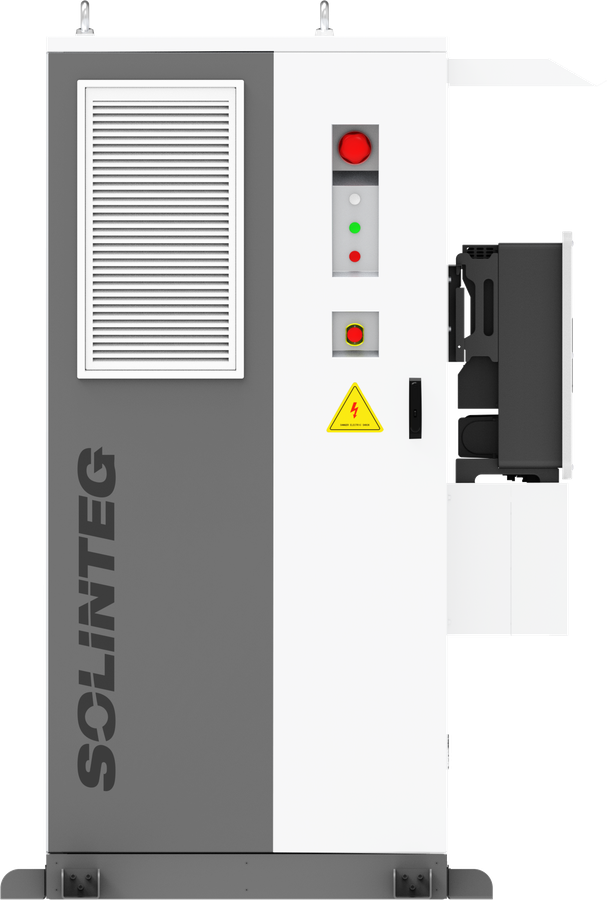
The All-In-One brings that work together in one product: Solinteg's M2HT hybrid inverter and E2BR battery cabinet, designed as a single system and tested at the factory before it ships.
Solinteg manufactures the All-In-One, and AERL supplies and supports it in Australia. AERL's engineers help installers design systems, prepare network applications and plan parallel and generator systems, and AERL handles warranty claims and technical support locally.
Most commercial solar and battery jobs are designed from scratch, with a different inverter, battery and switchboard each time. Every new combination means more design work, a new installation method, different commissioning steps and another set of spares. An installer who standardises on one product avoids most of that: the team gets faster with every job, and quoting becomes a matter of choosing the size.
The All-In-One is a complete solar and battery system in one outdoor cabinet, built around two standard sizes:
| System | Summary |
|---|---|
| 30/64 | 30 kW inverter with a 64.3 kWh battery |
| 50/112 | 50 kW inverter with a 112.5 kWh battery |
Larger sites use several identical systems connected together, up to 10 of them, so the same two products cover sites from 30 kW to 500 kW. The systems work with or without a grid connection, keep the site running during a power cut, and suit sites with mostly single-phase equipment as well as three-phase sites.
The cabinet arrives with the battery, switchboard, AC surge protection, maintenance bypass, emergency stop, backup power for its controls, fire detection and suppression, and air conditioning already installed and wired. On site, the main jobs are pouring the slab and installing the solar panels. Installation is almost as quick as for a small stackable battery, but the result has the safety features and serviceability that commercial and industrial sites need.
| Chapter | What it covers |
|---|---|
| 01 Two Standard Systems | The two systems, other sizes, single-phase loads and larger sites |
| 02 What's in the Cabinet | What comes built in, and how it compares with stackable systems |
| 03 Site Work | The installation steps, and what to check before you quote |
| 04 Choosing the System | A quick guide and example quotes |
| 05 Glossary | The technical terms used in this guide |
For detailed sizing, see the All-In-One System Sizing Guide. For installation and settings, see the All-In-One User Manual and the Solinteg M2HT 25–50 kW documents.
Each standard system pairs an inverter with a battery cabinet that matches it, so it can deliver its full rated power from the battery alone, at night or off-grid without solar.
| 30/64 | 50/112 | |
|---|---|---|
| Inverter | AIO-30K | AIO-50K |
| Battery cabinet | E2BR-S64K-C (4 packs) | E2BR-S112K-C (7 packs) |
| Rated output | 30.0 kW | 50.0 kW |
| Short-term peak (10 s) | 45 kVA | 75 kVA |
| Max. on one phase (230 V) | 10.0 kW | 16.7 kW |
| Battery energy (usable) | 64.3 kWh (57.87 kWh) | 112.5 kWh (101.25 kWh) |
| Battery power | 30.72 kW | 50 kW |
| Max. solar array | 60 kWp | 80 kWp |
| Generator input | 36.0 kVA | 60.0 kVA |
| Up to 10 in parallel | 60–300 kW | 100–500 kW |
Both systems can run connected to the grid, off-grid, or connected to the grid with backup, in which case they switch the site to battery power within 10 milliseconds of a power cut. Both also have an input for a backup generator.
The short-term peak is the power the system can supply for 10 seconds when equipment such as a motor or compressor starts. It is given in kVA, which includes the extra current that motors draw while starting.
The range also includes 25, 29.9 and 40 kW inverters and 80.3 and 96.4 kWh battery cabinets, and any inverter can be paired with any cabinet. Contact AERL if a site needs one of these combinations.
When choosing another combination, check the battery power as well as the energy. The battery can only deliver so much power, and that limit rises with the number of packs: the 64.3 kWh cabinet supplies up to 30.72 kW and the 80.3 kWh cabinet up to 38.4 kW. A 40 or 50 kW inverter therefore needs the 96.4 or 112.5 kWh cabinet to run at full power from the battery.
The All-In-One is a three-phase system, but it does not need the load to be shared evenly across the three phases. One phase can be fully loaded while another carries nothing (often described as 100% unbalanced load). It can also supply half-wave loads, such as some industrial rectifiers and heaters, which draw current on only half of each AC cycle. This makes it a good fit for sites where most of the equipment is single-phase, such as farm sheds, workshops, small offices and homesteads.
The limit is that each phase can supply only about a third of the system's total rating: 10.0 kW for the 30/64 and 16.7 kW for the 50/112. Size the system on the most heavily loaded phase rather than on the total load, and spread single-phase circuits across all three phases wherever you can.
A grid-connected system needs a three-phase grid supply, because a three-phase inverter cannot connect to a single-phase supply. Off-grid sites have no such constraint, because the All-In-One creates its own three-phase supply.
For sites above 50 kW, connect several identical systems in parallel. Up to 10 systems work together as one, each with its own battery and solar panels. One system acts as the master and shares the load evenly across the rest. A 150 kW site uses three 50/112s and a 200 kW site uses four, so even the largest jobs use the product your team already knows.
Parallel systems can also run connected to the grid, off-grid, or connected to the grid with backup. The backup arrangement needs one extra unit, the Solinteg EDA back-up box, which switches the site loads between the grid and the systems. Any grid-connected system needs approval from the local network service provider, and one with several inverters may also need central protection, a single protection relay that disconnects all the inverters if the grid fails. Raise it with the network service provider early.

Every system in a parallel group must be the same size. A 30/64 and a 50/112 cannot be connected together, so plan any future expansion around the same system.
A site-built system means sourcing an inverter, battery racks, a switchboard, isolators, AC surge protection, a maintenance bypass, fire detection, an emergency stop and backup power for the controls, then installing and wiring them all on site. The All-In-One delivers all of this in one weatherproof outdoor cabinet, wired and tested at the factory.
| Part | Details |
|---|---|
| Hybrid inverter | The Solinteg M2HT, which converts solar and battery power to AC for the site and charges the battery. It hangs on a bracket on the side of the cabinet, and the cables to the cabinet are supplied, already connected at the cabinet end. |
| Battery | 4 to 7 lithium iron phosphate (LiFePO4) battery packs, a safe and long-lived battery chemistry, with the battery management system (BMS) that monitors and protects them. |
| Switchboard | Grid and load circuit breakers and AC surge protection. |
| Maintenance bypass | A mechanically interlocked bypass, which keeps the site on grid power while the system is switched off for service. The interlock means the bypass and normal supply can never be switched on together. |
| Emergency stop | A button on the cabinet that shuts down both the cabinet and the inverter. |
| Backup power for controls | A built-in UPS (uninterruptible power supply) keeps the cabinet's controller, which monitors the battery and fire system, running for up to 2 hours after a complete power failure. It does not supply the site loads. |
| Fire protection | Temperature, gas and smoke detectors in the cabinet, and aerosol fire suppression, which releases a fine fire-extinguishing powder, both in the cabinet and in each battery pack. If a fire is detected, the main power circuit is disconnected. An inlet is also provided for an external fire-water supply. |
| Air conditioning | Heats and cools the cabinet to keep the battery within its operating temperature range. |
The cabinet is rated IP55, protected against dust and water jets, and the inverter IP66. The standard cabinet is rated for corrosion class C4, and a C5-rated cabinet is available for coastal and industrial sites. The system operates from −20 to 50 °C.
Stackable batteries, which are built from modules stacked on top of each other, are quick to install, but they are designed for homes and small businesses. On commercial and industrial sites they fall short in four ways:
| Typical stackable system | All-In-One | |
|---|---|---|
| Servicing | A faulty module often means dismantling the stack, and the site loses power while it is repaired | Mechanically interlocked bypass keeps the site on grid power during service |
| Emergency stop | Rarely fitted | Built in |
| Backup power for controls | Rarely fitted | Built-in UPS |
| Fire detection and suppression | Rarely built in; designed and installed separately | Built in, in the cabinet and every battery pack |
The All-In-One installs almost as quickly as a stackable system while meeting the requirements of a commercial site.
With the switchboard, fire protection and battery already in the cabinet, the main jobs on site are the slab and the solar panels. A typical installation follows these steps:
Parallel and generator systems also need the EDA back-up box or an automatic transfer switch (ATS), and communication cables between the systems. The wiring for each arrangement is in the Solinteg M2HT 25–50 kW Paralleling & Generator Guide.
The following site conditions are the ones most likely to change the scope or cost of a job, so check them during the site visit.
| Check | What to confirm |
|---|---|
| Access | A crane or forklift rated for at least 2 t can reach the slab. The cabinet weighs up to 1440 kg, and with the inverter fitted the system measures 1376 × 2262 × 1140 mm (W × H × D). |
| Separation | The distance from buildings meets the local fire code. Where it cannot, a fire wall is needed. A locked fence around the system is recommended. |
| Fire water | Fire-fighting equipment and a fire-water connection point are available. |
| Drainage | The slab is not in a spot where water collects. |
| Environment | Whether the site is within 2000 m of the coast or near heavy industry. If it is, order the optional C5-rated cabinet. |
| Supply | A grid-connected site has a three-phase supply, and the network service provider will approve the system size. |
| Load per phase | The most heavily loaded phase is within 10.0 kW for the 30/64, or 16.7 kW for the 50/112. |
Design and install the system to AS/NZS 3000, AS/NZS 4777.1, AS/NZS 5033 and AS/NZS 5139, and to AS/NZS 3010 if it includes a generator.
Start with two figures: the peak load on the most heavily loaded phase, and the energy the site uses overnight. Choose the 30/64 or the 50/112 to cover them, then add systems in parallel if the site needs more.
| Site | Starting point | Notes |
|---|---|---|
| Small commercial or farm, mostly single-phase equipment | 30/64 | Check that the heaviest phase stays within 10.0 kW. |
| Commercial building with three-phase equipment | 50/112 | Check that the overnight energy is within 101.25 kWh. |
| Off-grid homestead or station | 30/64 or 50/112 | Add a generator to cover long cloudy periods. |
| Large commercial or industrial | 2 to 10 × 50/112 in parallel | Covers 100–500 kW. |
If neither standard system fits, for example where a site needs much more storage than power, another combination may suit it better. The All-In-One System Sizing Guide covers inverter rating, battery, solar array design and generator sizing in full, with a worked example.
| Site | Quote |
|---|---|
| Farm shed: 20 kW peak, mostly single-phase, 50 kWh overnight | One 30/64 (57.87 kWh usable). Spread the single-phase circuits so that no phase exceeds 10.0 kW. |
| Office: 45 kW three-phase, 90 kWh overnight | One 50/112 (101.25 kWh usable, 50 kW battery power). |
| Factory: 180 kW three-phase | Four 50/112s in parallel (200 kW, 405 kWh usable). |
| Term | Meaning |
|---|---|
| ATS | Automatic transfer switch: switches the site between two power sources, such as the grid and a generator. |
| BMS | Battery management system: monitors and protects the battery packs. |
| Central protection | A single protection relay that disconnects all the inverters on a site if the grid fails or goes out of limits. |
| EDA back-up box | A Solinteg unit that switches the site loads between the grid and a group of parallel systems. |
| Half-wave load | Equipment that draws current on only half of each AC cycle, such as some industrial rectifiers and heaters. |
| Hybrid inverter | An inverter that handles solar, battery and grid power in one unit. |
| IP rating | Protection against dust and water. IP55 is protected against dust and water jets; IP66 is dust-tight and protected against powerful water jets. |
| kVA | Apparent power. It includes the extra current that motors and other equipment draw, so it is usually higher than the power in kW. |
| kWh / kWp | kWh is energy (how much the battery stores); kWp is the peak rated power of a solar array. |
| LiFePO4 | Lithium iron phosphate, a safe, long-lived lithium battery chemistry. |
| MPPT | Maximum power point tracker: an independent solar input that gets the most power from the strings connected to it. |
| Network service provider | The company that owns the local poles and wires, and approves grid connections. |
| Parallel | Several identical systems connected together and run as one larger system. |
| Unbalanced load | Load that is not shared evenly across the three phases. At 100% unbalance, one phase can be fully loaded while another carries nothing. |
| UPS | Uninterruptible power supply: keeps the cabinet's controls running when all other power is lost. |
For help with a design, a parallel or generator system, or a network application, contact AERL support on 1800 950 865 or [email protected].
The All-In-One cabinet and battery carry a 10-year product warranty and a 10-year, 70% performance warranty. The M2HT inverter carries a 5-year warranty, which can be extended to 10 years. Conditions apply; see the All-In-One Warranty Statement at aerl.com.au.
| Revision | Date | Change |
|---|---|---|
| 1.0.0 | 11 / 2026 | First issue. |
If you have any questions or need support, contact AERL.
Sincerely,
The AERL Team
AERL Pty Ltd · 1/75 Bluestone Circuit, Seventeen Mile Rocks QLD 4073 · 1800 950 865 · [email protected] · aerl.com.au
Australian Energy Research Laboratories
1/75 Bluestone Circuit
Seventeen Mile Rocks QLD 4073
Australia